1
Place is 3 dimensional which we're perfectly aware of in the modern age through computer technology and the cinematic experience, that wants to evolve and evolve, non touch 3 dimensional media and virtual reality. We're bombarded by reminders of the glory of our 3 dimensional existence, in every facet of the imagination, whether it is on a screen or images created through sound and modern music. It is an experience that has "length, breadth and depth." The body is defined by what is extended in 3 dimensions," and this technology in its own right is contained within various digital forums.
2
What is death? Death is simply a forcible occurrence that returns us back to our sole completely and in total. Place is a difficult notion but no where near as complex as death. I defend Martin Heidegger on this subject. He explained the importance of Dasein which could also be interpreted as sole or spirit. It is a state by which we can see the colour, the shapes and the forms of our existence, as if through the light of a window or through the walls of a cave, which he discussed in 'The Basic Problems Of Phenomenology' in the section about prehistoric man and his affliction towards painting. The reason for Art is to let people into your sole through image making.
3
It is impossible for place to be a body which renders space itself as formless, because the forms within spaces have volume, a shape and a mass. The Native Americans for instance created a set of laws for these entities, told stories and treated them in a spiritual and mathematical way, to ensure survival and understand the nature of their environment, because this planet is sometimes alien, with all sorts of mysteries. We consider it to be our home that we have claimed as a possession, that belongs to us, not to the spider, the fly and those creatures that we can't see, in the wild or beneath the oceans.
Friday, 29 March 2013

Thursday, 14 March 2013
Problems concerned with digital Technology
The rooms that I occupy and exterior places are pictures in my psyche. They include the ones that are various apps and windows on the Internet, in digital format, within the tunnels and compartments of PlayStation 1.2 or the future of 3 Dimensional non touch virtual realities. These are all locations that our psyche has to process, rationalise and make sense of. Seeing beyond them is at times difficult. As painters we are beyond these realms, often witnessing terrible injustices and violence upon the sole, and so we sometimes question the path that we have chosen or doubt the work that we do. We see both extremes, the calm and the violence.
I can only observe and realise fixed circumstances that have to be utilised. Painting is an ancient science created by technology and intended as an antidote, when technologies start to dominate our lives. It brings something very human into the equation, which is painful for those who want quick and easy answers, that require the least physical contact. It penetrates and supersedes these digital realities, preventing the world from escalating too quickly. We start to question whether there is such a thing as a real place, because in digital format it has no volume or body. Technology is dominating the images of perception.
The real Artist is in his or her studio with brushes, tubes and canvas, phone and computer. Once painting has served it's purpose and is in on a screen, it has no use any more, apart from the continuing servitude of a place such as the Internet. This is why, it is imperative to preserve Art and disassociate some of our lives from the digital age. Deep underground a priceless artifact is salvaged because data has been collated on its whereabouts. I suppose our first task is to find the genus or sense of place that modern reality characterises, so that we can build a positive outlook, because it is a revolution. We should be cautious, revolutions can lead to war and inevitably fail.
I can only observe and realise fixed circumstances that have to be utilised. Painting is an ancient science created by technology and intended as an antidote, when technologies start to dominate our lives. It brings something very human into the equation, which is painful for those who want quick and easy answers, that require the least physical contact. It penetrates and supersedes these digital realities, preventing the world from escalating too quickly. We start to question whether there is such a thing as a real place, because in digital format it has no volume or body. Technology is dominating the images of perception.
The real Artist is in his or her studio with brushes, tubes and canvas, phone and computer. Once painting has served it's purpose and is in on a screen, it has no use any more, apart from the continuing servitude of a place such as the Internet. This is why, it is imperative to preserve Art and disassociate some of our lives from the digital age. Deep underground a priceless artifact is salvaged because data has been collated on its whereabouts. I suppose our first task is to find the genus or sense of place that modern reality characterises, so that we can build a positive outlook, because it is a revolution. We should be cautious, revolutions can lead to war and inevitably fail.
Friday, 1 March 2013
Spirit and Place
The spirit has returned. It is because in writing we focus on words and line that form the letters. Place is a more difficult philosophy than finite and infinitude. Dissemble the word infinitude and it suggests that its place is within a 'finite' whole. The whole is not out or beyond finite but inside and contained. This was Aristotle's dispute and he argued that these false postulations need to be readdressed. Within a line, the one that forms words or even our signature create an expressive, erroneous and perfect form. The spirit is beauty. It is found within the form of who we are.
If we're lost, we are found again within the infinite symmetry of line, that reminds us of the place from which we derived and where we belong. I had some concept of this when I was 15 producing my first serious paintings, when I dedicated my life to the intelligences of tone and contrasted colours. (We can apply white over dark but not dark over white. I could only do the paintings wet. The first way we decide to do things is probably the best way.) Here I am returned to the spirit that does not contain itself within a shape that has absolute limit, where nothing can advance beyond.
An outline that doesn't desist its movement, encourages and gives it the freedom to be what it infinitely is, something that persists and is at times a reflection of sublimity. Its opposite includes all the crossing outs, if you wish to observe a less articulate commentary. Eloquence is equal to rhetoric and so didactic must be its opposite for a debate to be a good work of Art. For any work of Art to be successful there is a big difference between an eloquent line and a not so eloquent line, whether it is a line of speech in a word or a line in drawings makes no difference either, as well as a painting and a line of posture for a dancer.
If we're lost, we are found again within the infinite symmetry of line, that reminds us of the place from which we derived and where we belong. I had some concept of this when I was 15 producing my first serious paintings, when I dedicated my life to the intelligences of tone and contrasted colours. (We can apply white over dark but not dark over white. I could only do the paintings wet. The first way we decide to do things is probably the best way.) Here I am returned to the spirit that does not contain itself within a shape that has absolute limit, where nothing can advance beyond.
An outline that doesn't desist its movement, encourages and gives it the freedom to be what it infinitely is, something that persists and is at times a reflection of sublimity. Its opposite includes all the crossing outs, if you wish to observe a less articulate commentary. Eloquence is equal to rhetoric and so didactic must be its opposite for a debate to be a good work of Art. For any work of Art to be successful there is a big difference between an eloquent line and a not so eloquent line, whether it is a line of speech in a word or a line in drawings makes no difference either, as well as a painting and a line of posture for a dancer.

Tuesday, 5 February 2013
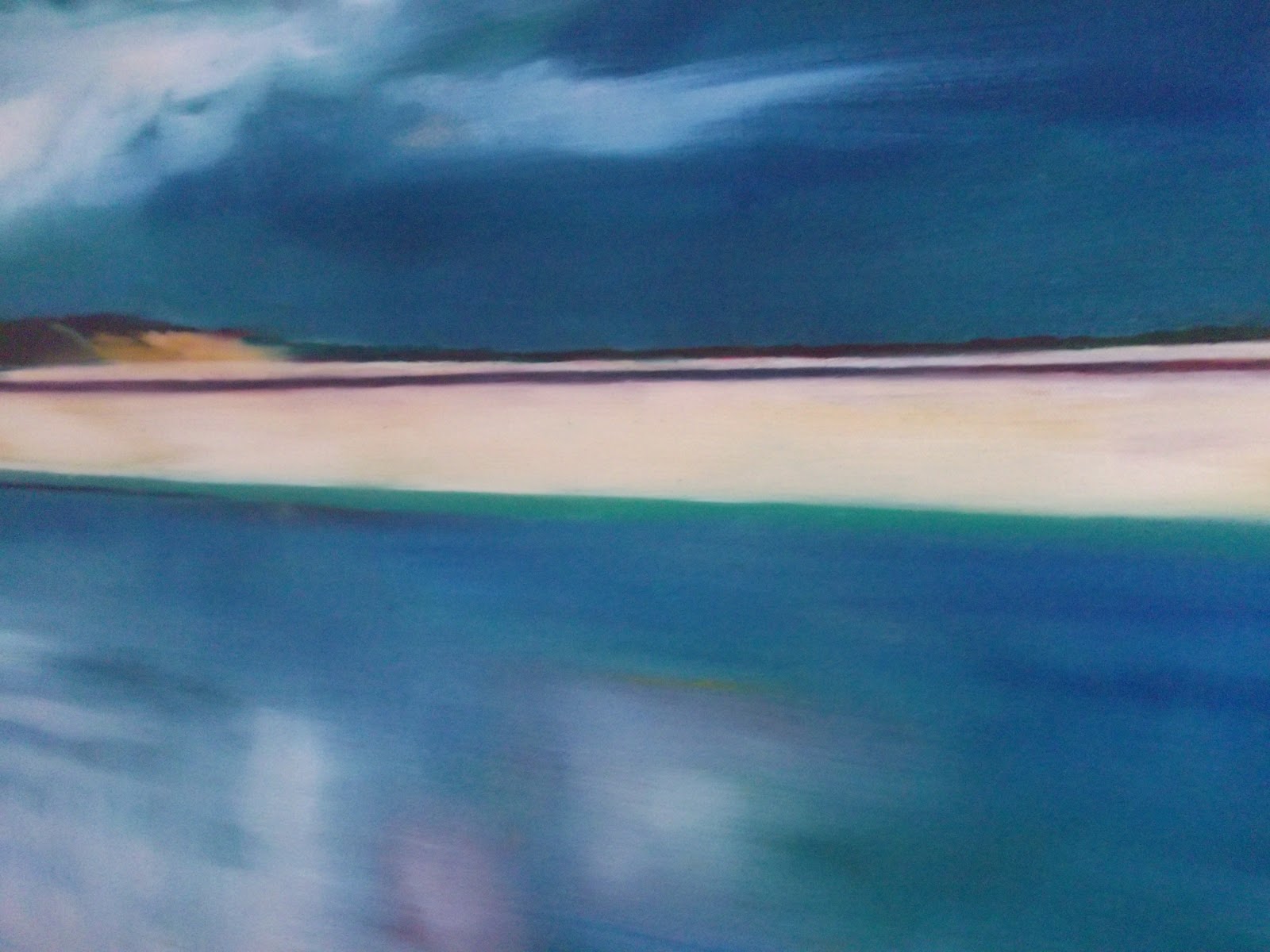
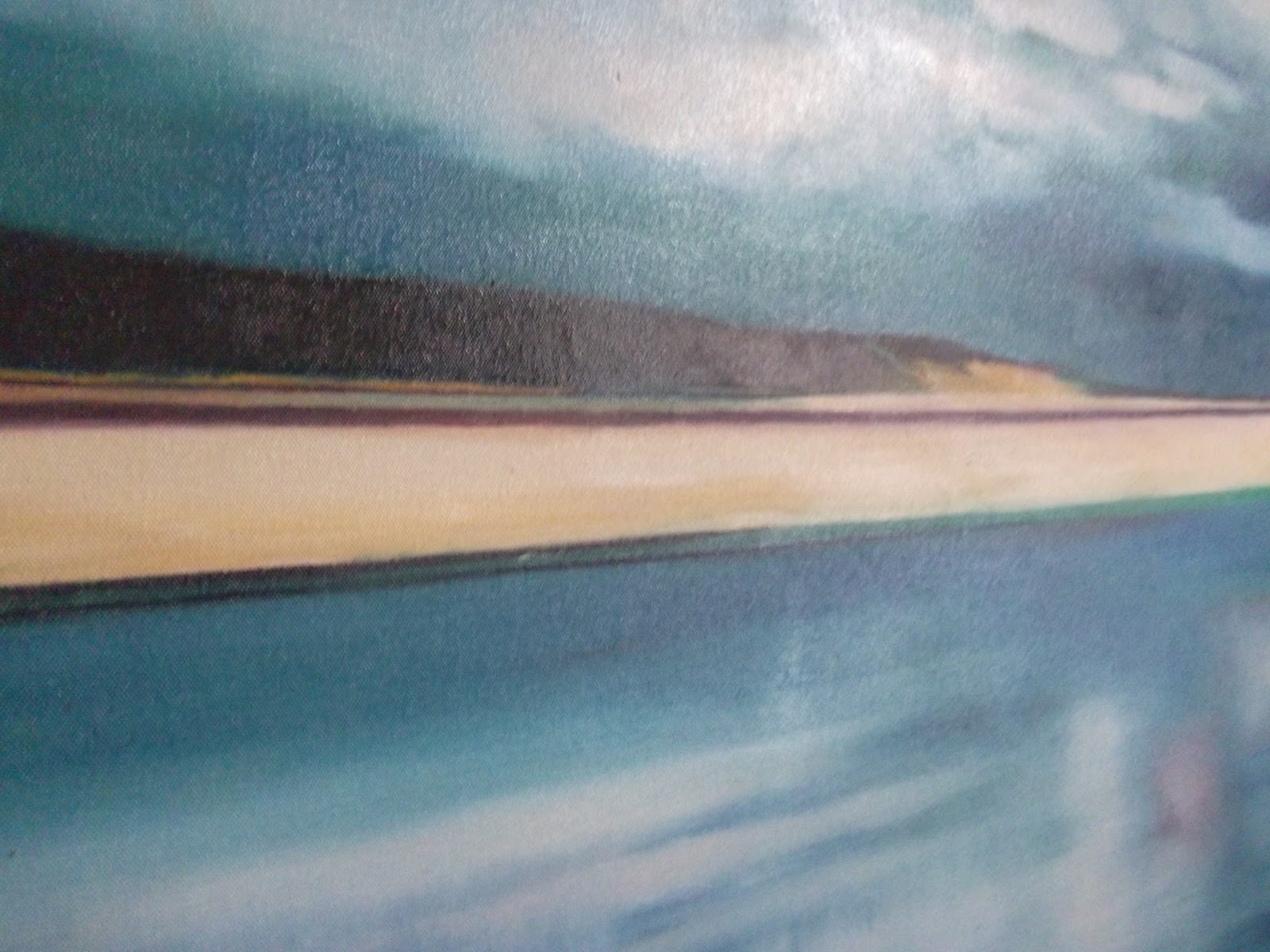
The paintings are now entirely about accidents. During the next year I will continue on the theme of reflections inspired by Saunton Sands in North Devon
I have also started another blog entitled, 'The Journal of an Artist.' which has been taken from a small note book. It's a philosophical work of comedy and should be regarded as pure fiction on www.hegelsplan.blogspot.com.
Note about numbers
Things never occur on a first accident because it is probable that it is the result of some thing that has already happened. Two accidents are random and one isn't, because it is only by either subtraction or addition that 1 can change it's form. This transformation has a 3rd causation in actuality. The third attempt is normally when things are successful. I attempt to find a colour twice for instance and on the third occasion it appears.
In physics (the study of atoms,) two accidents are known as collisions. The problem with painting is, the less we're aware of mathematics and science the less control we have. In my experience creativity just stops if we don't pay attention to the mechanics behind it. The study of numbers is important in my work at the moment so that it can be structured. Example, if I find a colour on the 2nd attempt, I may search again anyway, just to even things out. From practical experience however we don't employ these systems as logically as I suggest, but to think through some of these ideas can be intriguing.
Some simple basic principles
There are 10 forms altogether that start with 0. We count them as 0,1,2,3,4,5,6,7,8,9. Just look at any computer key board. The number 10, combines 0 and 1 and 11, 1 and 1, 20, 2 and 0. Other examples, there are 9 months gestation, 9 planets and one X with an irregular orbit, 10 fingers, 0 fingers are 0 fingers. Two fists are therefore called something else. The point being, if you count all the numbers on the keyboard including 0, there are ten. Also 10 was the golden number for ancient Greek mathematicians, like Pythagoras. This pattern then repeats itself. One accident becomes a second accident and on the third we observe it's outcome. The 4th accident becomes the 5th, the outcome is number 6. I would like to add, that 7 is an important number because it is the beginning of the final outcome of a set of 10 forms and 3 is the end of 2 previous accidents. Get my drift? The term one for good luck has relevance as well because including o, the extra 1 is number 10, which=11. One for good luck is always optional which means we choose whether we bring a thing into the equation or not at all. It has a random pattern which doesn't have to be predicted. Once we hit 9 forms including 0, we posit 1 or not 1 for good luck. The number 10 has been superseded and the forms start all over again.
I was commissioned to paint an 8' family portrait in 2008. There is an example entitled, Parkhouse family on www.Johnsonsburyart.blogspot.com. It took me 9 months in total to complete, which including 0 is 10 forms. If I analysed it using this system, it may have been apparent that the portrait was divided into 3 sections or processes. Other examples are past, present, future and foreground, middle ground and background etc.
Accidents are physical things, in everyday life. Painting is only part of the process. I would like to add, call it a coincidence, whilst I was writing this blog, the doorbell rang twice. One was a parcel delivery man and the other a woman who both wanted to know directions. The outcome is, whilst I'm writing the blog today, another parcel delivery man? It is all association, and ways of structuring random events in time. The word Ekstasis may also be useful for further study. A third example, I was developing photo's in Boots chemist. The first machine didn't work and the second didn't work either, but the third did. Also, think of Goldilocks and the three bears. First bowl of porridge, too hot, second too cold, third, just right.
I have also started another blog entitled, 'The Journal of an Artist.' which has been taken from a small note book. It's a philosophical work of comedy and should be regarded as pure fiction on www.hegelsplan.blogspot.com.
Note about numbers
Things never occur on a first accident because it is probable that it is the result of some thing that has already happened. Two accidents are random and one isn't, because it is only by either subtraction or addition that 1 can change it's form. This transformation has a 3rd causation in actuality. The third attempt is normally when things are successful. I attempt to find a colour twice for instance and on the third occasion it appears.
In physics (the study of atoms,) two accidents are known as collisions. The problem with painting is, the less we're aware of mathematics and science the less control we have. In my experience creativity just stops if we don't pay attention to the mechanics behind it. The study of numbers is important in my work at the moment so that it can be structured. Example, if I find a colour on the 2nd attempt, I may search again anyway, just to even things out. From practical experience however we don't employ these systems as logically as I suggest, but to think through some of these ideas can be intriguing.
Some simple basic principles
There are 10 forms altogether that start with 0. We count them as 0,1,2,3,4,5,6,7,8,9. Just look at any computer key board. The number 10, combines 0 and 1 and 11, 1 and 1, 20, 2 and 0. Other examples, there are 9 months gestation, 9 planets and one X with an irregular orbit, 10 fingers, 0 fingers are 0 fingers. Two fists are therefore called something else. The point being, if you count all the numbers on the keyboard including 0, there are ten. Also 10 was the golden number for ancient Greek mathematicians, like Pythagoras. This pattern then repeats itself. One accident becomes a second accident and on the third we observe it's outcome. The 4th accident becomes the 5th, the outcome is number 6. I would like to add, that 7 is an important number because it is the beginning of the final outcome of a set of 10 forms and 3 is the end of 2 previous accidents. Get my drift? The term one for good luck has relevance as well because including o, the extra 1 is number 10, which=11. One for good luck is always optional which means we choose whether we bring a thing into the equation or not at all. It has a random pattern which doesn't have to be predicted. Once we hit 9 forms including 0, we posit 1 or not 1 for good luck. The number 10 has been superseded and the forms start all over again.
I was commissioned to paint an 8' family portrait in 2008. There is an example entitled, Parkhouse family on www.Johnsonsburyart.blogspot.com. It took me 9 months in total to complete, which including 0 is 10 forms. If I analysed it using this system, it may have been apparent that the portrait was divided into 3 sections or processes. Other examples are past, present, future and foreground, middle ground and background etc.
Accidents are physical things, in everyday life. Painting is only part of the process. I would like to add, call it a coincidence, whilst I was writing this blog, the doorbell rang twice. One was a parcel delivery man and the other a woman who both wanted to know directions. The outcome is, whilst I'm writing the blog today, another parcel delivery man? It is all association, and ways of structuring random events in time. The word Ekstasis may also be useful for further study. A third example, I was developing photo's in Boots chemist. The first machine didn't work and the second didn't work either, but the third did. Also, think of Goldilocks and the three bears. First bowl of porridge, too hot, second too cold, third, just right.

Monday, 7 January 2013
Something that potentially is implies that it will in the future actually be, if it is deemed possible. Let us say that an existence that has formed itself totally around a premise that is finite, life and all activity will cease and then it will disappear because everything about it relies on this (apparent) fact, but it does only explain a form or forms that consist of things that derive and are eventually erased. Our focus is normally directed towards a possibility that can be realistically fulfilled within the time that we have, but what if something, (such as painting) requires a much longer period connected to the very slow activity that it requires. Some Minimalists believed, one true single work of Art was adequate.
This is not my current project of course. Something that potentially is, implies that in the future it will actually be. My work in a philosophical sense will in actuality be infinite. It exists beyond a realm that is merely finite? however the world we are in now has expiry dates and reminders stamped all over it. It is all we can predicate so far unfortunately.
Surely once we have firstly accounted for and completed everything that has a definite outcome in this universe, then we have to face a reality that no longer has a clear point of resolution, or one that has no resolution at all. It gets boring when we predict outcomes all the time. A random process is made intricate. We are so involved in our current study that we can not see its outcome! To focas on where it will arrive and then discontinue is a distraction. Innocence returns at this point. Example- the Seascapes are one series of paintings and I can clearly see how they will be shown with audio in a slightly darkened room, because they are about light, just like a screen is lit.
This is not my current project of course. Something that potentially is, implies that in the future it will actually be. My work in a philosophical sense will in actuality be infinite. It exists beyond a realm that is merely finite? however the world we are in now has expiry dates and reminders stamped all over it. It is all we can predicate so far unfortunately.
Surely once we have firstly accounted for and completed everything that has a definite outcome in this universe, then we have to face a reality that no longer has a clear point of resolution, or one that has no resolution at all. It gets boring when we predict outcomes all the time. A random process is made intricate. We are so involved in our current study that we can not see its outcome! To focas on where it will arrive and then discontinue is a distraction. Innocence returns at this point. Example- the Seascapes are one series of paintings and I can clearly see how they will be shown with audio in a slightly darkened room, because they are about light, just like a screen is lit.
Subscribe to:
Posts (Atom)